
It’s the week before Thanksgiving break. Half your class is already mentally at Grandma’s house, the other half wants to know if we’re “doing anything fun,” and you still want them learning real history. I’ve been there every November.
Here’s what I learned: the week before break can be one of the best weeks of the year for history. The real story of 1621 is more interesting than the version most of our students grew up with, and middle schoolers love finding out the textbook got something wrong.
Here are five Thanksgiving activities for middle school social studies, starting with a few you can do with nothing but a whiteboard.
1. Open with a Thanksgiving Myth or Fact Warm-Up
Write five statements on the board and have students vote myth or fact before you reveal anything:
- The Pilgrims called their 1621 feast “Thanksgiving.” Myth. They never used that name for it.
- The main meat was deer. Fact. Wampanoag hunters brought five deer.
- There was pumpkin pie. Myth. The colonists had no ovens and almost no sugar.
- About 90 Wampanoag men came to the gathering. Fact. They outnumbered the English almost two to one.
- Thanksgiving has always been on the fourth Thursday of November. Myth. Congress didn’t set that date until 1941.
The arguing is the point. The students who were sure about the pumpkin pie will want to know why they were wrong, and now they’re ready to read.
2. Read the One Eyewitness Account of 1621
Almost everything we know about the 1621 harvest comes from a single letter. Edward Winslow wrote it in December 1621, describing how Massasoit arrived “with some ninety men, whom for three days we entertained and feasted.”
Put that line on the board and ask three questions. What does Winslow tell us? What doesn’t he tell us? Whose side of the story is missing? It’s a five-minute primary source lesson, and it shows students that history depends on who wrote things down.
3. Ask What the Wampanoag and the Pilgrims Each Needed
This is the question I’d build the whole week around: Why did the Wampanoag and the Pilgrims come together in 1621?
Both sides needed something. A disease from 1616 to 1619 had killed as many as nine out of ten people in some Wampanoag towns, while the rival Narragansett nation had been spared. Massasoit needed allies. The Pilgrims needed to survive. About half of the 102 Mayflower passengers died that first winter, and Tisquantum (Squanto), who had learned English after an English captain kidnapped him in 1614, taught them to plant corn with fish.
When students see the harvest as an alliance instead of a dinner party, the whole story makes more sense, including why the peace didn’t last. If you’re heading into the colonies after break, everything I have for that unit is on my 13 Colonies page.
4. History of Thanksgiving Stations: Fix the Textbook
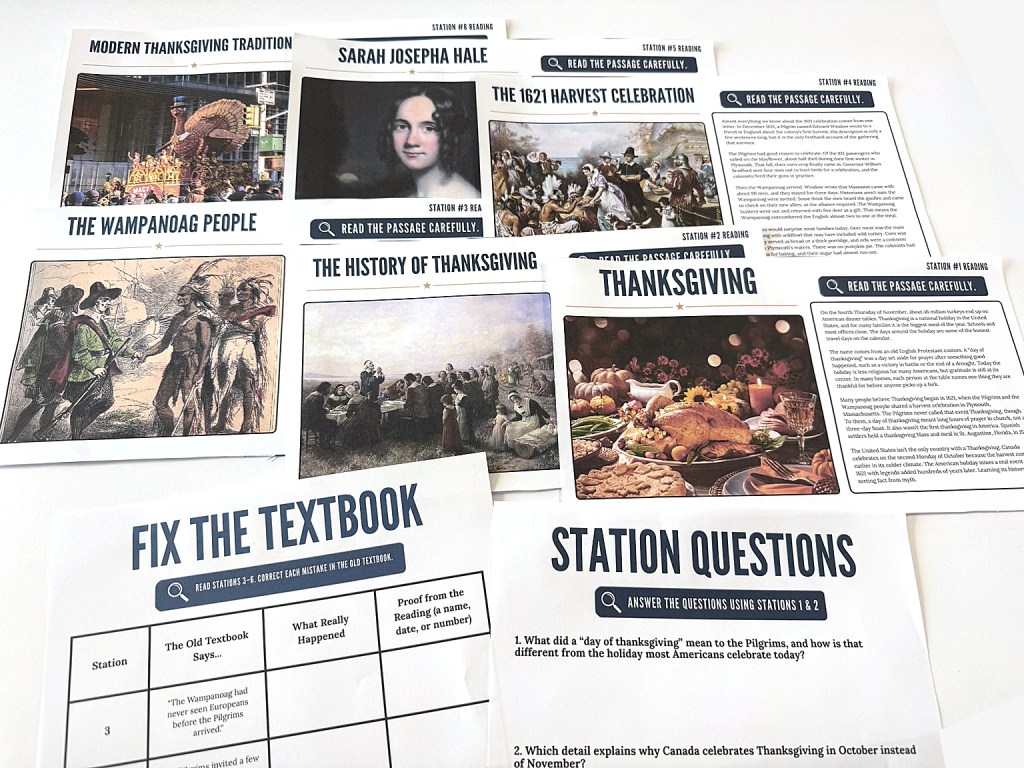
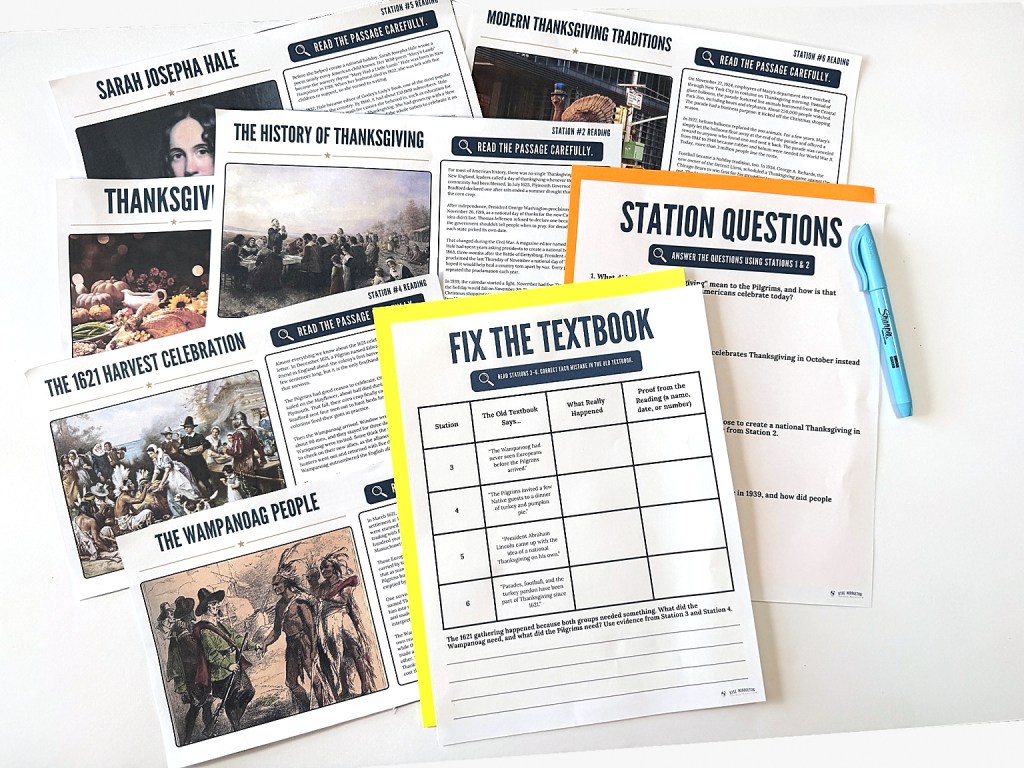
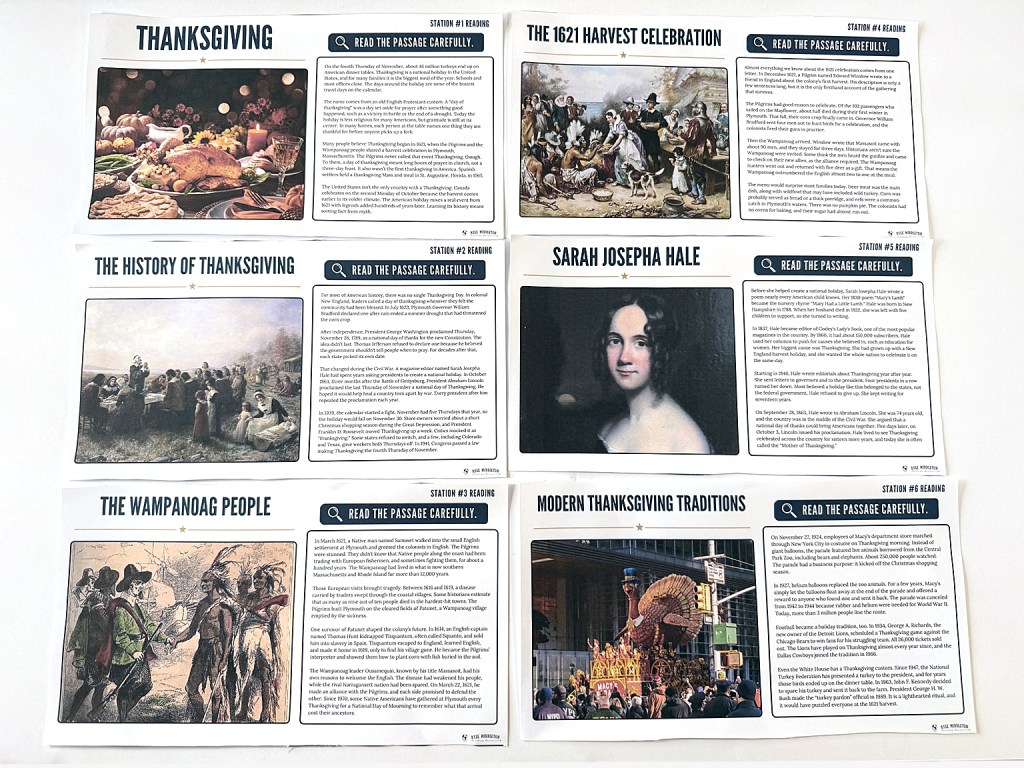
If you want a ready-made version of all this, my History of Thanksgiving Stations are built around it. Students read six short stations, from the Wampanoag and the 1621 harvest to Sarah Josepha Hale, Lincoln, and modern traditions.
Then they fix four mistakes in an imaginary old textbook and back up each correction with a name, date, or number. (The Macy’s parade didn’t start until 1924, and the turkey pardon didn’t become official until 1989.)
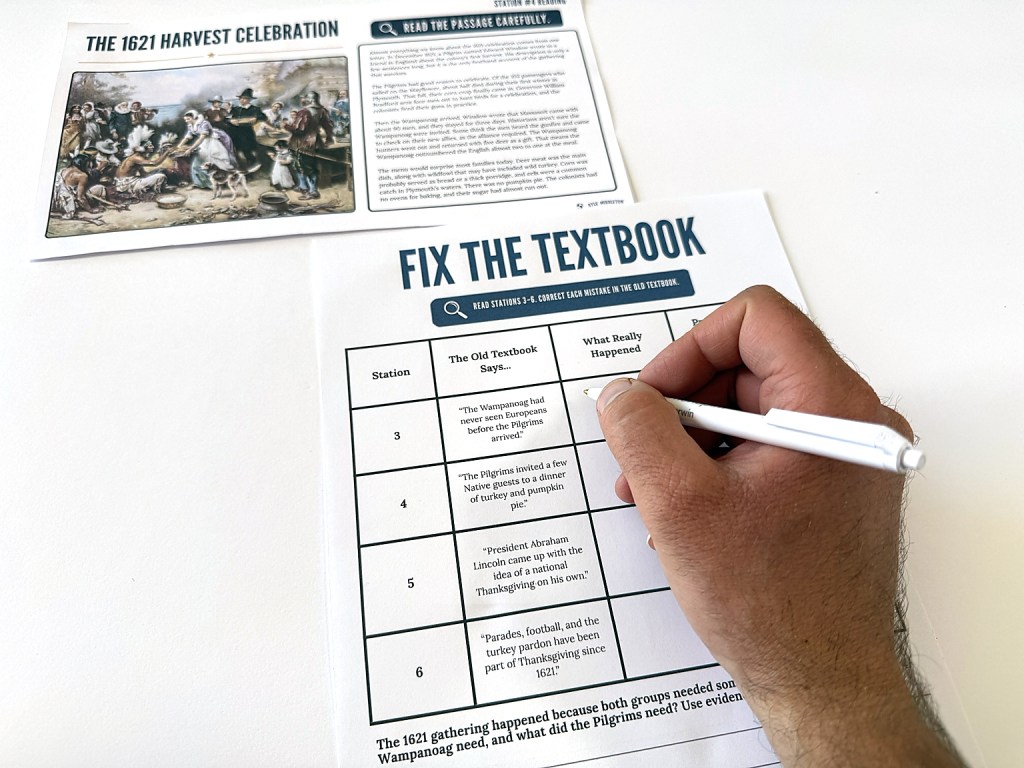
It takes about 40 minutes. You print the six readings and place them around the room, or staple them into a desk packet if you’d rather keep students in their seats.
5. A Thanksgiving Escape Room for the Day Before Break
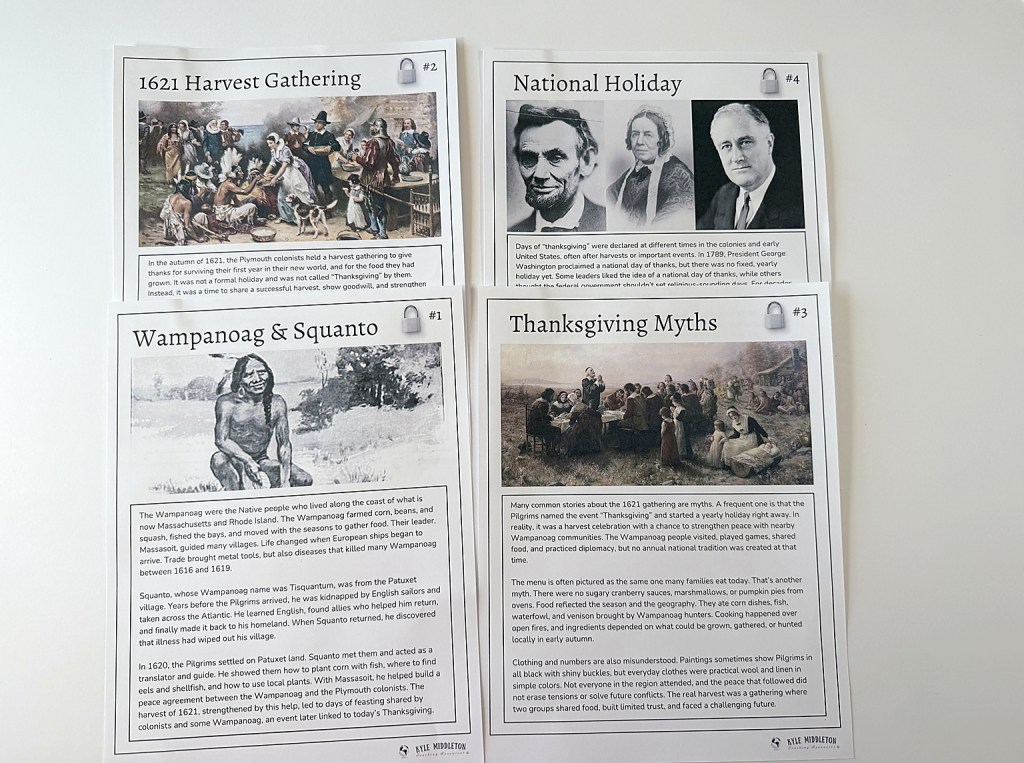
For the last day before break, when nobody wants a worksheet, I use my History of Thanksgiving Escape Room. Students read four short passages: the Wampanoag and Squanto, the 1621 harvest gathering, Thanksgiving myths, and how it became a national holiday. Each reading unlocks with three questions and a decoder challenge (Morse code, pigpen, a Caesar cipher, and a Polybius square), and the four answers build the final escape code.
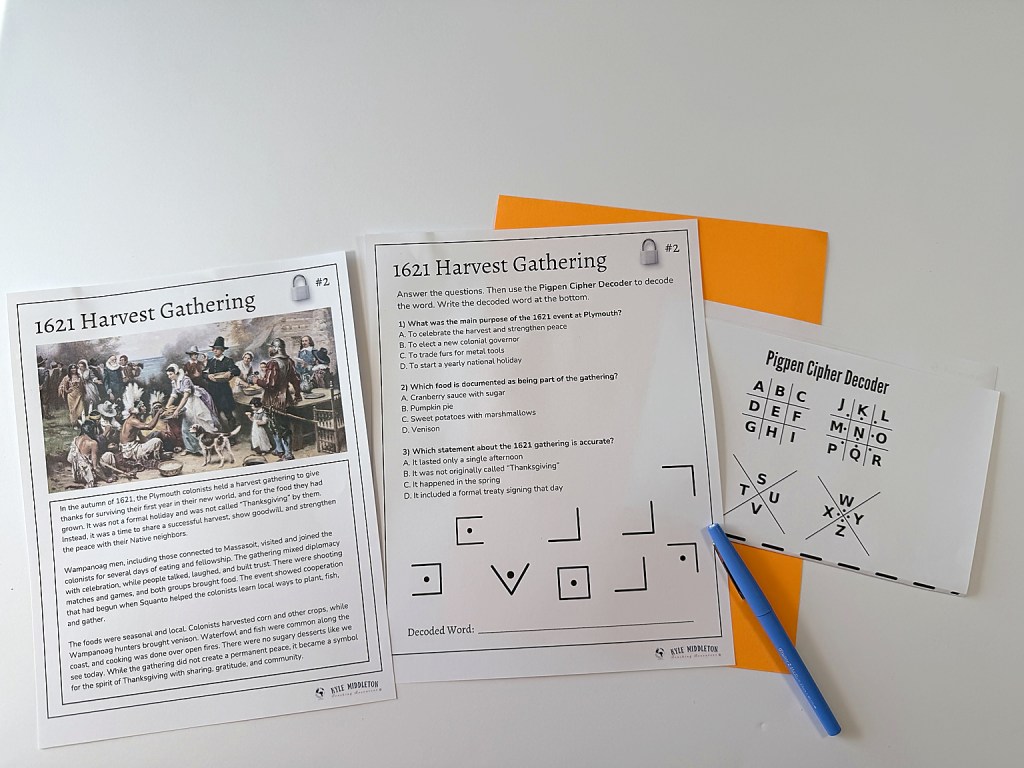
Plan on 45 to 60 minutes. Prep is printing the pages, one set of decoders per group, and scissors for the Caesar cipher wheel. There’s also a self-checking Google Forms version if you’d rather go digital. My favorite part is watching a group realize the last lock spells out a name they read about twenty minutes earlier.
Teaching the colony itself? The Plymouth Colony Escape Room covers the Mayflower Compact and the Wampanoag. You can also browse all of my holiday escape rooms, from Christmas around the world to New Year’s.
Try an Escape Room Free
Never run an escape room before? Start with a free one. My Jamestown Escape Room is yours when you join my email list, and it fits right into a colonial unit.
However you spend the week, give your students the real story. It’s better than the myth, and they’ll remember the day they found out nobody at the first Thanksgiving ate pumpkin pie.
Happy Thanksgiving,
Kyle


Leave a Reply