
Ask a class of eighth graders to name the British acts that led to the American Revolution, and most of them can give you one: the Stamp Act. The Sugar Act, the Quartering Act, the Townshend Acts, and the Intolerable Acts blur into one long list of “taxes the colonists didn’t like.”
That’s a problem, because the acts and taxes are the whole argument of the Road to Revolution. If students can’t tell them apart, the Boston Tea Party and Lexington and Concord seem to come out of nowhere.
Here’s how I teach the acts and taxes from 1763 to 1774 so students can follow the story, including three facts that surprise them every time.
Start with One Question, Not a List of Dates
A list of eight laws is hard to care about. One question is easier. I put this on the board before we start: How did British acts and taxes from 1763 to 1774 change colonists’ ideas about rights and government?
Now every law has a job. Students aren’t memorizing the Sugar Act. They’re asking what the Sugar Act did to the way colonists thought about Parliament. By the end, they can see the change: in 1763 most colonists were proud to be British, and by 1774 twelve colonies were sending delegates to the First Continental Congress.
Three Facts About the Acts That Surprise Students
You can use these tomorrow with nothing but a whiteboard. Write each one as a true or false statement and let students vote first.
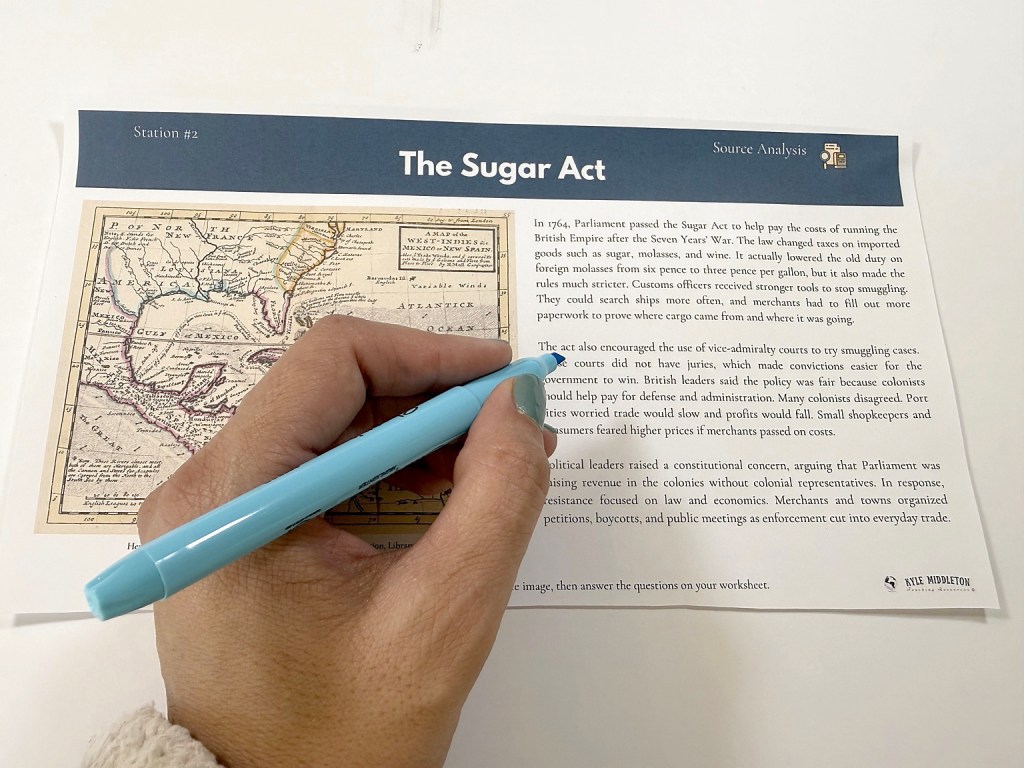
The Sugar Act lowered a tax. In 1764, Parliament cut the duty on foreign molasses from six pence a gallon to three. So why were merchants angry? Because Britain started collecting it. Customs officers searched more ships, and smuggling cases went to vice-admiralty courts that had no juries. Students realize the fight was never only about the money.
The Quartering Act of 1765 did not put soldiers in people’s homes. Most students (and plenty of adults) believe it did. The law said soldiers went to barracks first, then to inns and alehouses, then to empty houses and barns. Colonists were angry about paying for an army in peacetime, and that’s a better discussion than the myth.
Britain had reasons. The Proclamation of 1763 was meant to stop costly fighting between settlers and Native nations west of the Appalachians. The taxes were meant to help pay for the war Britain had just fought. When students see both sides, they stop reading the unit as good guys against bad guys and start weighing the arguments.
Acts and Taxes Stations: Eight Sources, One Class Period or Two
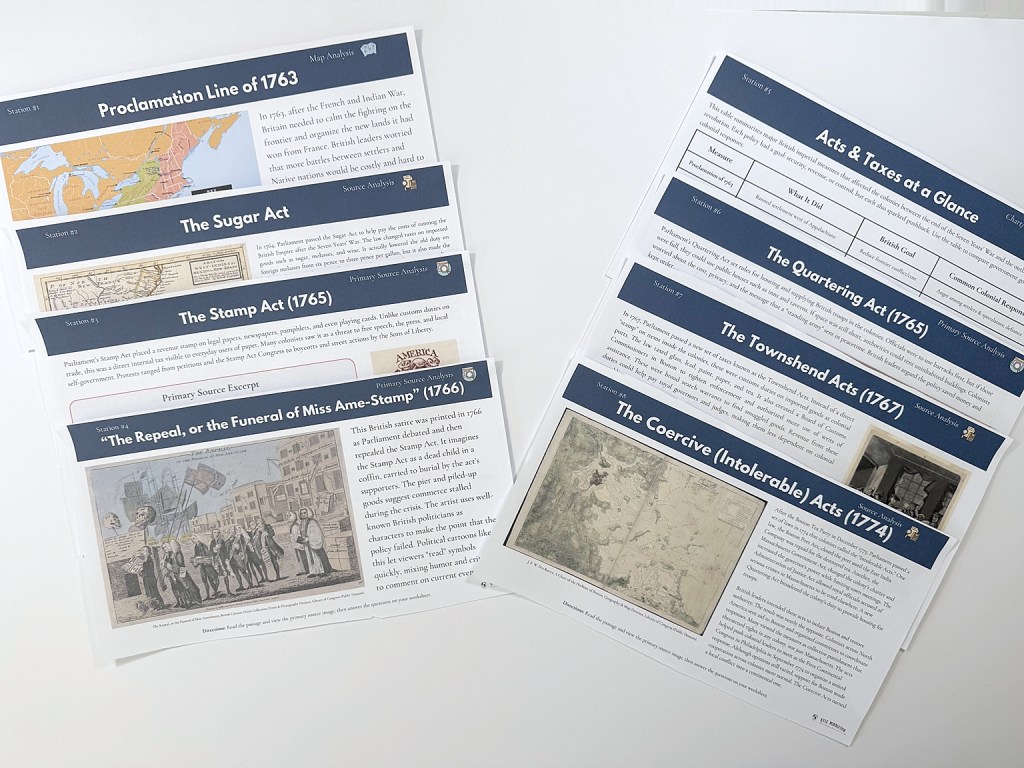
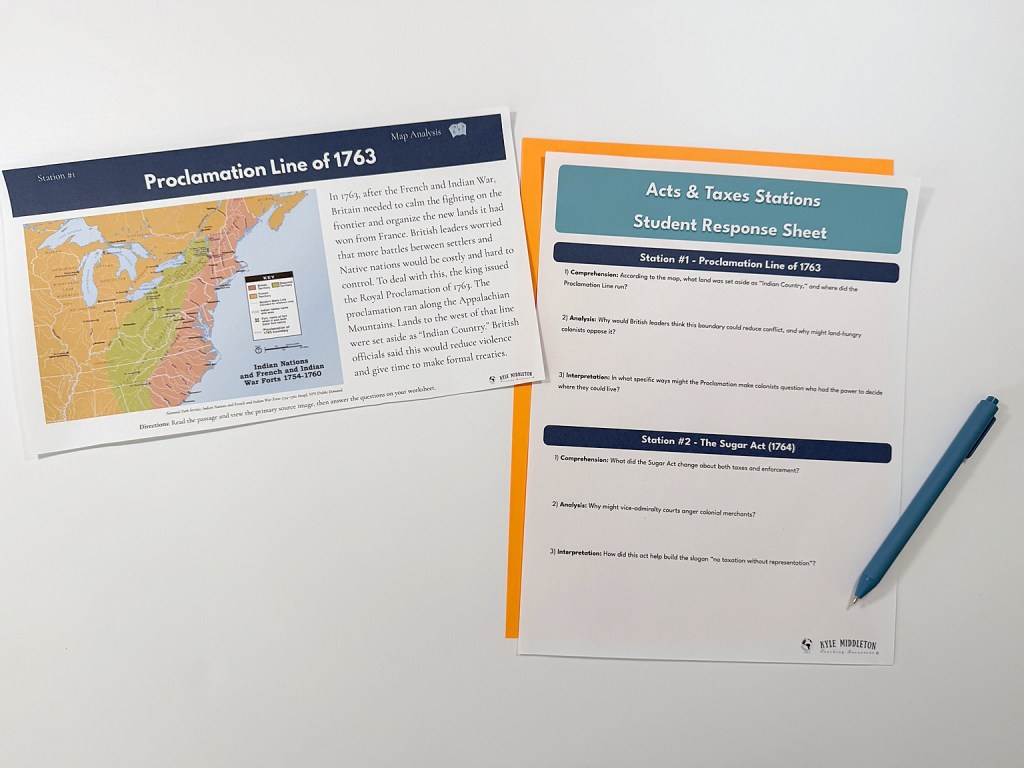
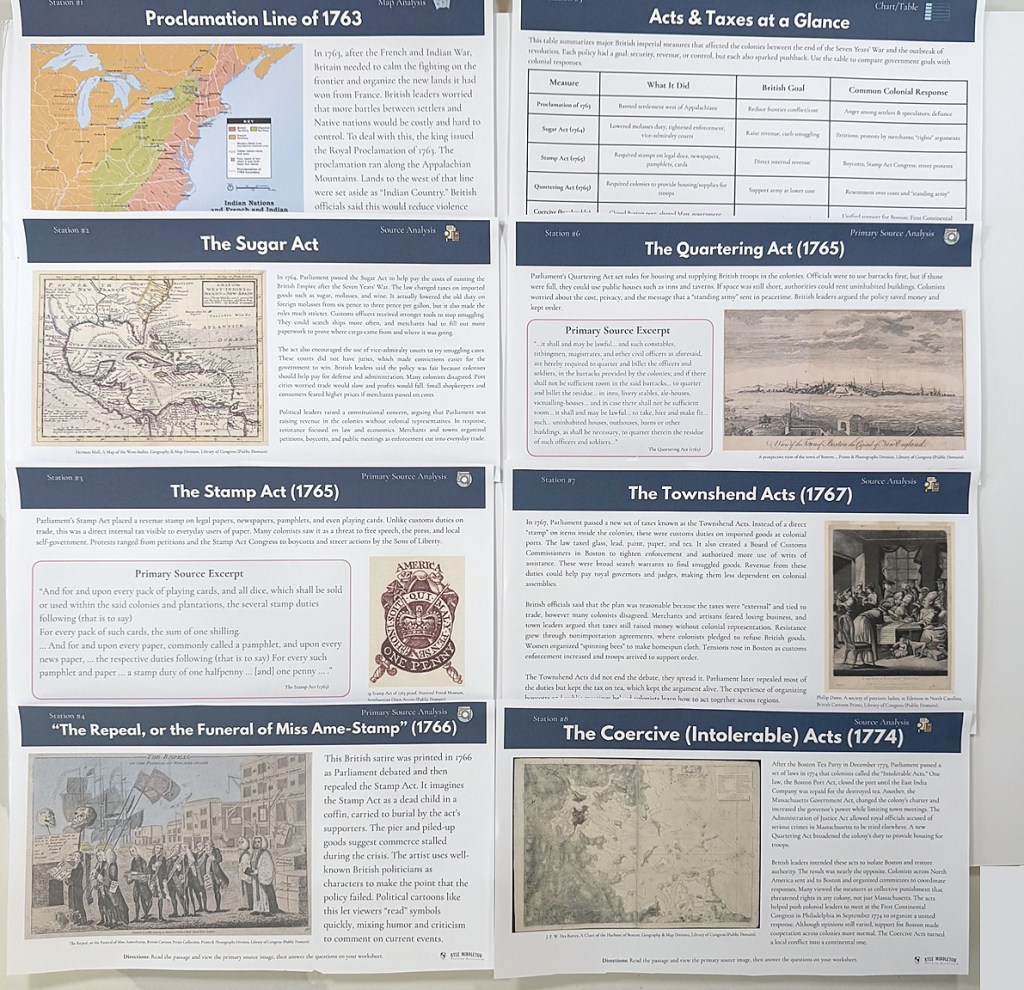
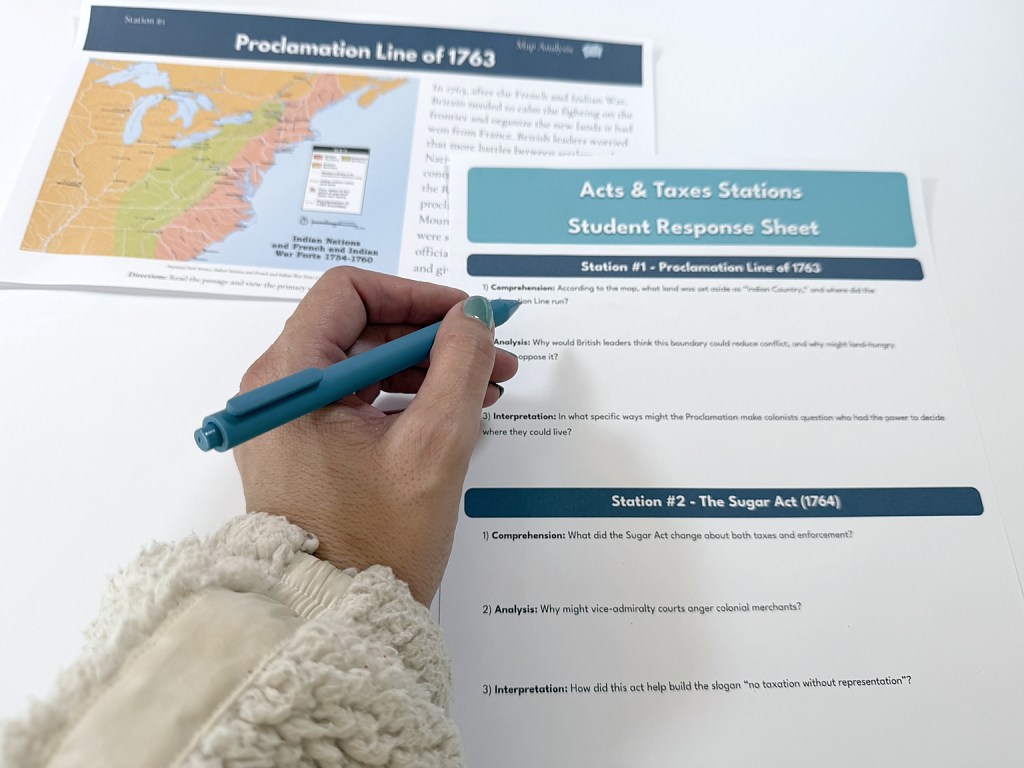
If you want this ready to go, my Acts and Taxes Stations walk students through the whole stretch from 1763 to 1774. Each station has a short reading and a real source: a map, a law in its own words, or a political cartoon.
- Proclamation Line of 1763: a map of the line along the Appalachian Mountains
- The Sugar Act (1764): lower tax, stricter enforcement
- The Stamp Act (1765): an excerpt from the law, including one shilling on every pack of playing cards
- “The Funeral of Miss Ame-Stamp” (1766): a British cartoon showing the Stamp Act carried to its grave in a tiny coffin
- Acts and Taxes at a Glance: a chart comparing what each law did, what Britain wanted, and how colonists responded
- The Quartering Act (1765): the law’s own words on where soldiers could stay
- The Townshend Acts (1767): taxes on glass, lead, paint, paper, and tea, and the boycotts that followed
- The Coercive (Intolerable) Acts (1774): Boston’s port closed after the Tea Party
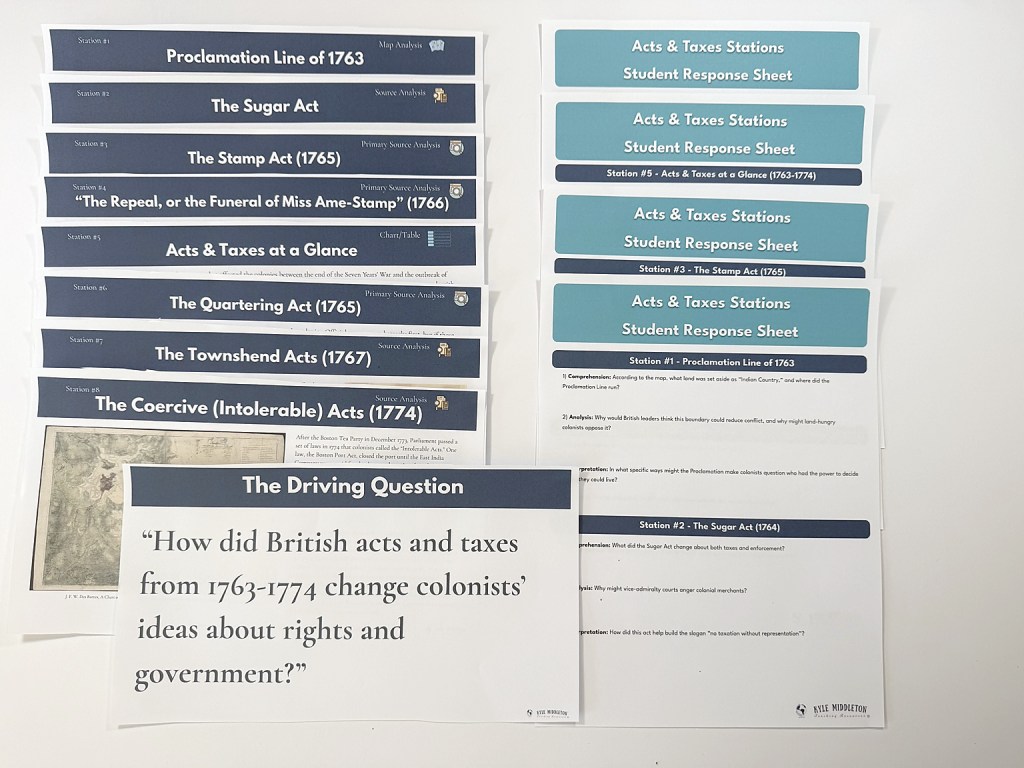
At every station, students answer three questions that get harder as they go: one comprehension, one analysis, and one interpretation. At the Stamp Act station, for example, they name two items the law taxed, explain why this tax was easier to notice than earlier trade duties, and then decide how a tax on newspapers and pamphlets could change public debate.
How to Run It
Print the eight cards and place them around the room, or keep students seated and pass the cards from group to group. Plan on 6 to 10 minutes a station. That’s about 90 minutes in all, so it fits one block or two regular class periods. If you only have one period, split the class so each group does four stations and then teaches the other half.
Students finish with a RACE response that answers the driving question with evidence from at least two stations. A rubric and an answer key with sample responses are included, and the student pages are editable. There’s a Google Slides version too.
Review the Unit with a Road to Revolution Escape Room
Once students know the acts, they’re ready for the events the acts caused: the Boston Massacre in 1770, the Boston Tea Party in 1773, and the first shots at Lexington in 1775. When it’s time to review, I use my Road to Revolution Escape Room. Students read short passages, answer questions, and crack a code for each one, so the review day is the one they ask to do again.
I’m also building a full Road to Revolution unit, with one lesson for each big event. Six more are ready now. In the French and Indian War Stations, students prove how winning a war led to trouble. In the Stamp Act Stations, they choose to petition, boycott, or protest, then find out what colonists really did. The Boston Massacre DBQ asks which source to trust, and the Boston Tea Party Activity compares how four people saw the same night. The Intolerable Acts Lesson traces why Britain cracked down on Boston, and Paul Revere’s Ride: Fact or Myth? checks Longfellow’s poem against the people who were there. You can find them all with the rest of my American Revolution activities.
Try an Escape Room Free
Never run an escape room before? Start with a free one. My Jamestown Escape Room is yours when you join my email list, and it’s a good fit for the colonial unit that comes right before this one.
However you teach it, give students the question first and the laws second. The acts stop being a list to memorize, and the Revolution starts to make sense.
Kyle


Leave a Reply