
The last week before winter break is a hard week to teach. Students are thinking about presents and snow days, and you’re trying to hold on to one more real lesson. Colonial Christmas is my favorite way to do that, because it’s a holiday topic that is also real history.
Most students assume colonists celebrated Christmas the way we do. They didn’t. One colony made it illegal. Others threw parties that lasted almost two weeks. Here are four colonial Christmas activities for middle school that work the week before break, and most of them need nothing but a whiteboard.
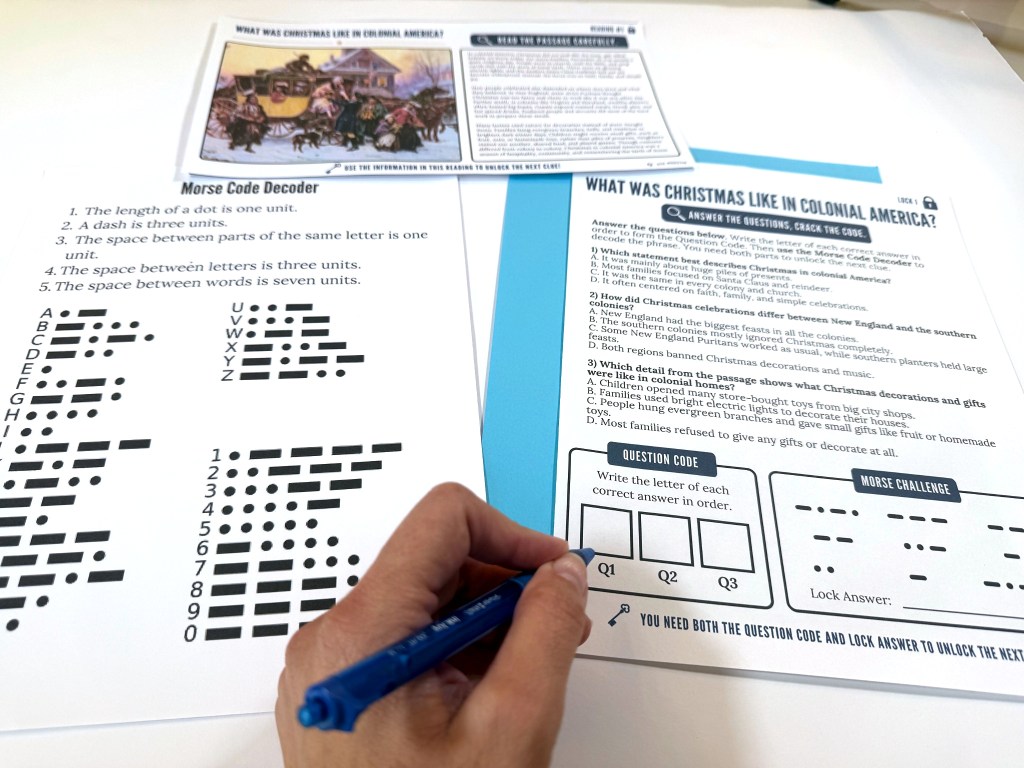
An Easy Colonial Christmas Activity: Then and Now
Draw two columns on the board: Christmas Today and Christmas in the Colonies. Give students two minutes to fill the first column. You’ll get electric lights, Santa, a pile of presents, and a day off school.
Then fill in the second column together. There were no electric lights, so families put candles in the windows. Santa Claus as we know him didn’t really catch on until the 1800s, after Clement Clarke Moore’s poem “A Visit from St. Nicholas” came out in 1823. Children might get fruit, nuts, or a homemade toy. Homes were decorated with evergreen branches, holly, and mistletoe from outside. And Christmas wasn’t a federal holiday until 1870.
Finish by having students circle what stayed the same. Food, family, music, and visiting neighbors make the list almost every time.
The Colony That Banned Christmas
This is the fact that wakes up a tired class. In 1659, Massachusetts passed a law that fined anyone five shillings for celebrating Christmas, whether that meant skipping work or holding a feast. The law stayed on the books until 1681.
Why would anyone ban Christmas? The Puritans pointed out that the Bible never gives a date for Jesus’ birth. They also remembered Christmas in England as a season of heavy drinking and rowdy street parties, and they didn’t want that in their towns.
Pair the law with a story from Plymouth. On Christmas Day in 1621, Governor William Bradford called the men out to work. Some newcomers said working on Christmas went against their conscience, so he let them stay home. When he came back at noon, he found them playing games in the street. He took the games away and told them they could pray at home, but not play in public.
Then ask one question and let students move to a side of the room: Should a government be allowed to ban a holiday? It’s a quick, real debate about religion, rules, and freedom.
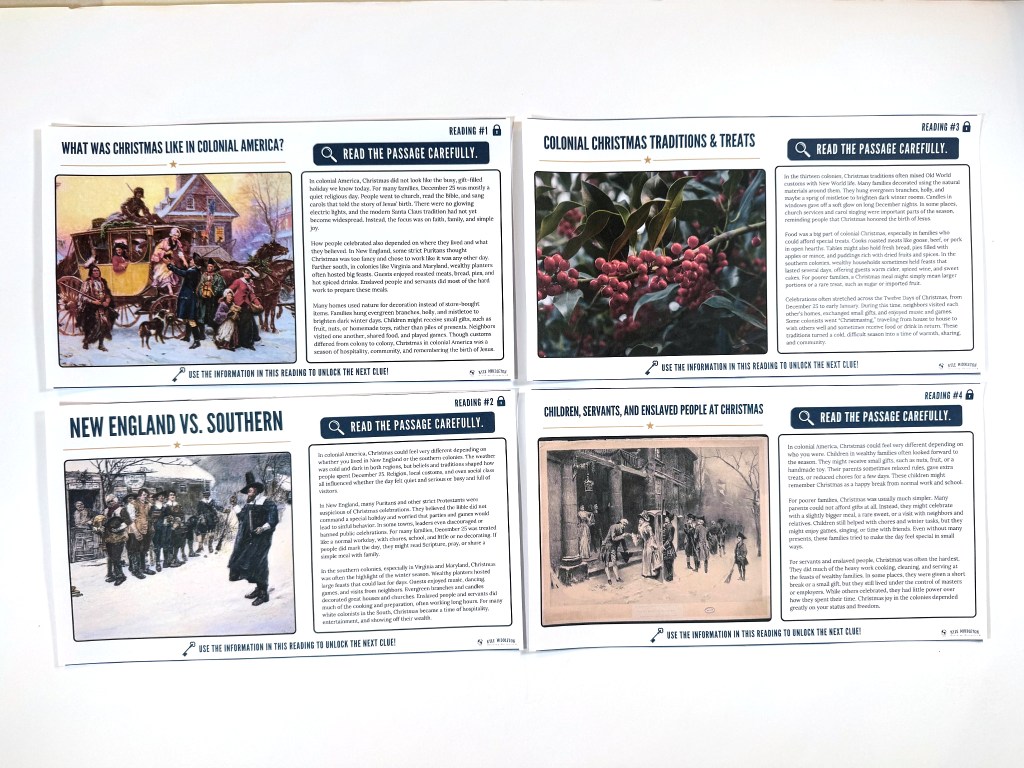
Twelve Days of Christmas in Virginia
Now flip to the southern colonies. In Virginia and Maryland, Christmas was the high point of winter. The season ran from December 25 to January 6, and wealthy planters filled those twelve days with feasts, dancing, card games, and visits. George Washington even married Martha Custis on January 6, 1759, on Twelfth Night.
But someone had to cook all that food. On many plantations, enslaved people did the cooking, cleaning, and serving. Some were given a few days off at Christmas, but they still had very little control over their own time. Ask students: Who got to enjoy a colonial Christmas, and who did the work? It turns a fun topic into a real look at status and freedom in the colonies.
Colonial Christmas Escape Room: Four Readings, One Class Period
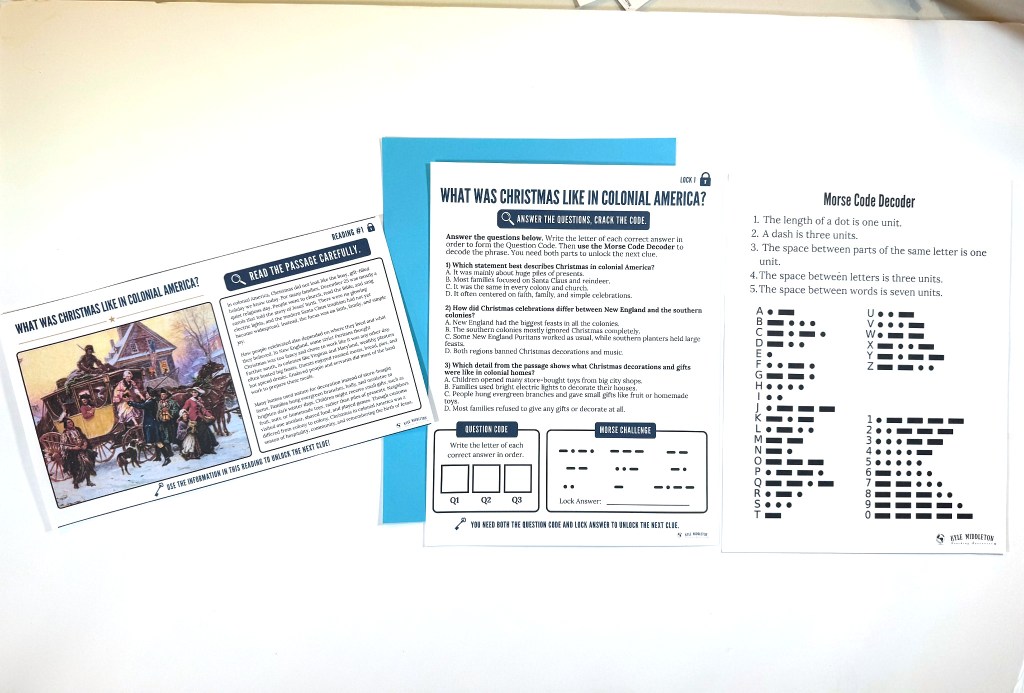
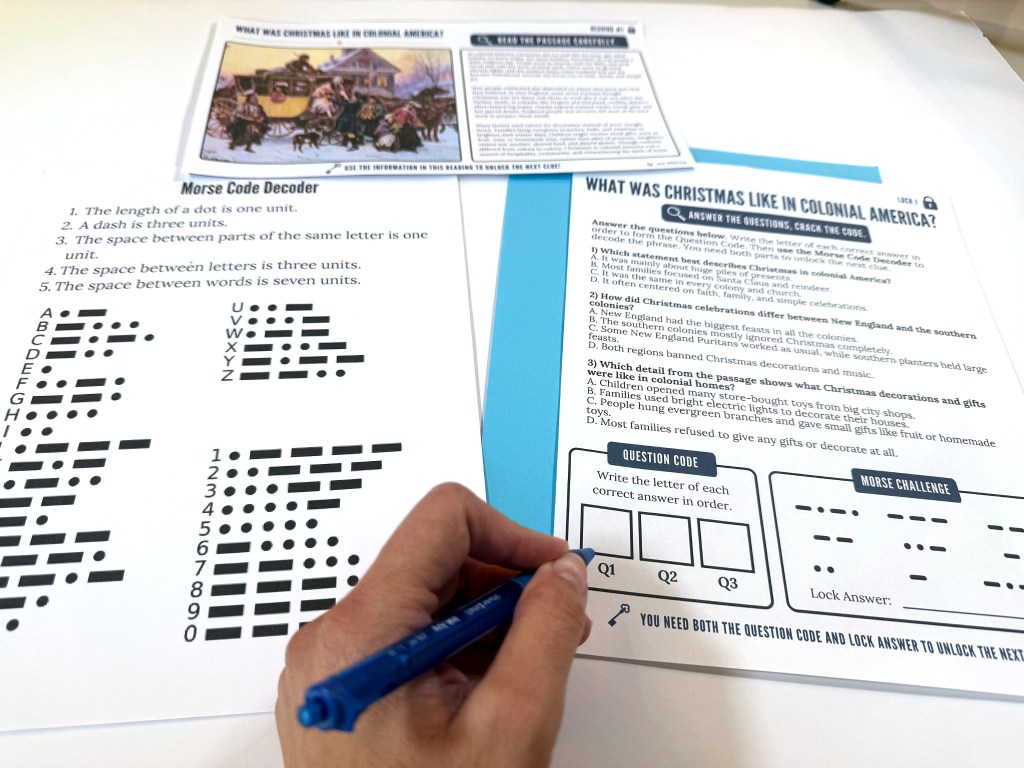
If you want all of this ready to go, my Colonial Christmas Escape Room puts it into one lesson. Students read four short passages:
- What was Christmas like in colonial America? church, carols, and simple gifts
- New England vs. Southern: a quiet workday in one region, a days-long feast in the other
- Colonial Christmas Traditions and Treats: roast goose, mince pies, candles in the windows, and “Christmasing” from house to house
- Children, Servants, and Enslaved People at Christmas: how the holiday felt depending on who you were
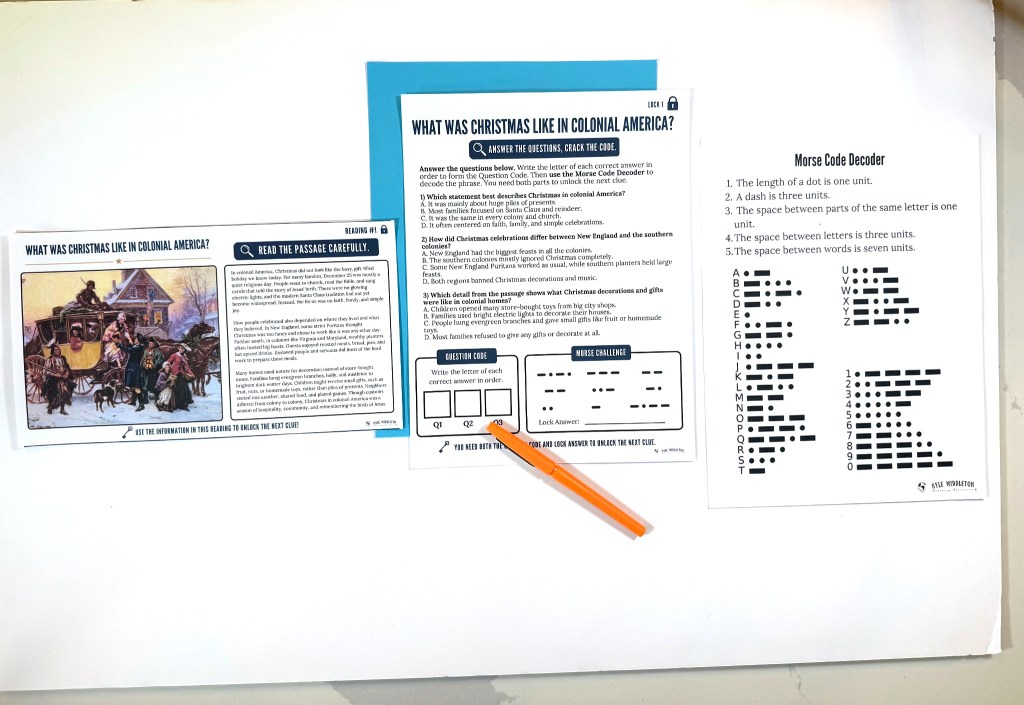
After each reading, students answer three questions. The letters of their answers make a Question Code, and then they use a decoder to crack the lock. That’s 12 questions, 4 locks, and 5 decoders, ending with a Final Escape Code.
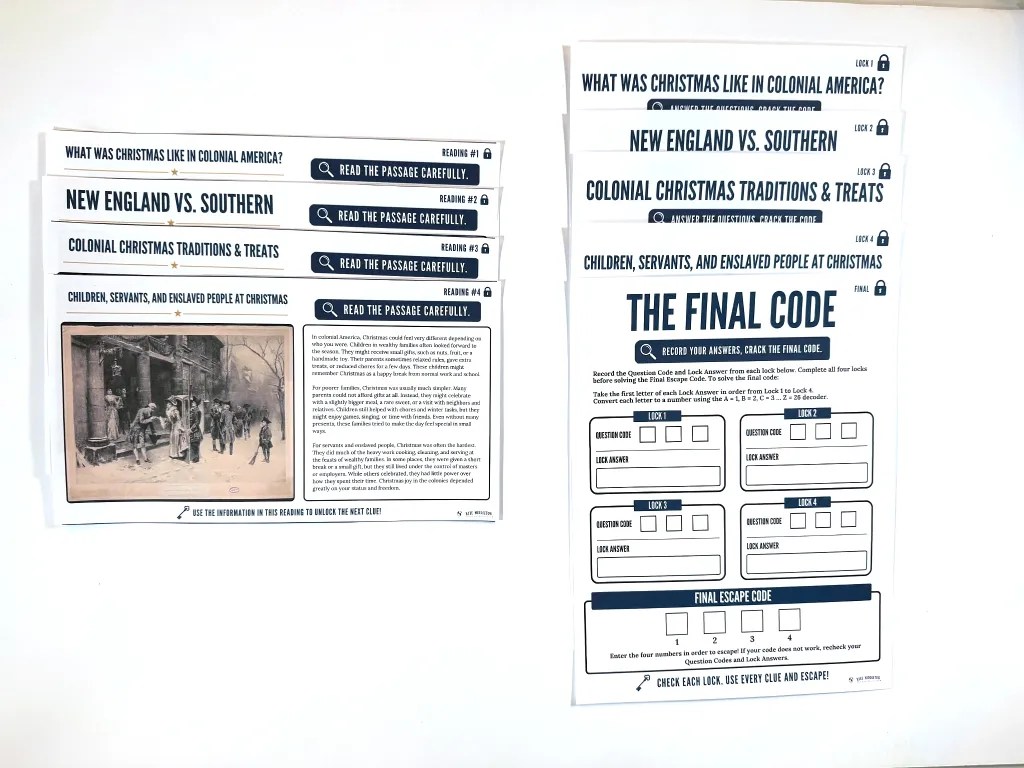
How to Run It
Plan on 45 to 60 minutes. Print the readings, the question and lock pages, the Final Code page, and one decoder set per student or pair. Have scissors out for the Caesar wheel.
You can hand out the whole packet at once, or use Checkpoint Mode: give one lock at a time and check it before students get the next one. Students can work alone or with one partner. The teacher answer key has every question answer, lock answer, and the final code, and there’s a self-checking Google Forms version if you’re short on paper that week.
Teaching the Revolution in December? Try Christmas 1776
If your class has already moved past the colonies, there’s a perfect Christmas story in the Revolution too. On Christmas night in 1776, George Washington led about 2,400 soldiers across the icy Delaware River. The next morning they surprised the Hessian soldiers at Trenton and captured close to 900 of them. After months of losing, it was the win the Continental Army needed.
Want more Christmas history? My History of Christmas Escape Room covers how the holiday changed over time. You can find all of my holiday escape rooms in one place, and the rest of my 13 Colonies activities on the unit page.
Try an Escape Room Free
Never run an escape room before? Start with a free one. My Jamestown Escape Room is yours when you join my email list, and it fits right into your colonial unit.
The week before break doesn’t have to be a movie week. Give students one surprising fact, like a colony that banned Christmas, and they’ll want to know the rest of the story.
Kyle


Leave a Reply